You can check every point below in the app. Where another kind of app does better, the last sections say so.
1. A score for each dish
Each entry in Matcha is one dish at one place, scored from 1 to 10 in half steps. Each score also has a word, from “Skip it” below 4 to “Perfect” at 10, which you see when you score a dish in a shared list.
The restaurant still gets a number: your average across the dishes you had there. On the map, its pin shows the score of the best dish you had, so a place with one perfect plate stands out even if the rest was only fine. How to rate food has tips for scoring the same way every time, and restaurant tracker app shows where those averages appear.
2. Every food gets its own ranking, and the foods are yours
Pizza, ramen, gelato, cinnamon roll: each food you log gets its own list, best first, across every city you’ve had it in. You name the foods. Call one “Iced matcha” or “Cacio e pepe” and it gets a ranking of its own. From any food’s page you can rename it, merge it into another food or delete it.
Rankings also sort by city, restaurant and year. When a new dish takes first place in its food, Matcha shows it as your new #1 and names the place it beat. The matcha rating app page shows how one food’s ranking looks up close.
3. Your taste instead of crowd stars
Every ranking in Matcha comes from your own scores. Matcha has no public reviews and doesn’t predict what you’ll like. The only other scores in the app are your friends’: in a list you share, or on places they send you.
Matcha doesn’t use AI either. You choose the dish and give the score, and place suggestions come from Apple Maps and from where your photo was taken.
That also means Matcha can’t tell you where to eat in a city you’ve never been to. For that, search the map (the results come from Apple Maps) or start from our city guides, such as croissants in Paris. Matcha vs Google Maps lists compares your own scores with public stars in more detail.
4. Private by default
You don’t create an account. Your dishes, photos and notes are stored on your iPhone, and Matcha has no feed or followers. Friends see only what you send them and the dishes you put in a list you share.
Matcha sends usage statistics and crash reports, which never include the names of your dishes, places or lists, your photos or your notes. It also tells Meta when the app opens, to measure Matcha’s own ads. Profile › Share usage data turns all of that off.
The app shows no ads, because the subscription pays for it. Profile › Export data saves your dishes, lists and places as a file, with your photos in a folder.
5. Blind scoring in shared lists
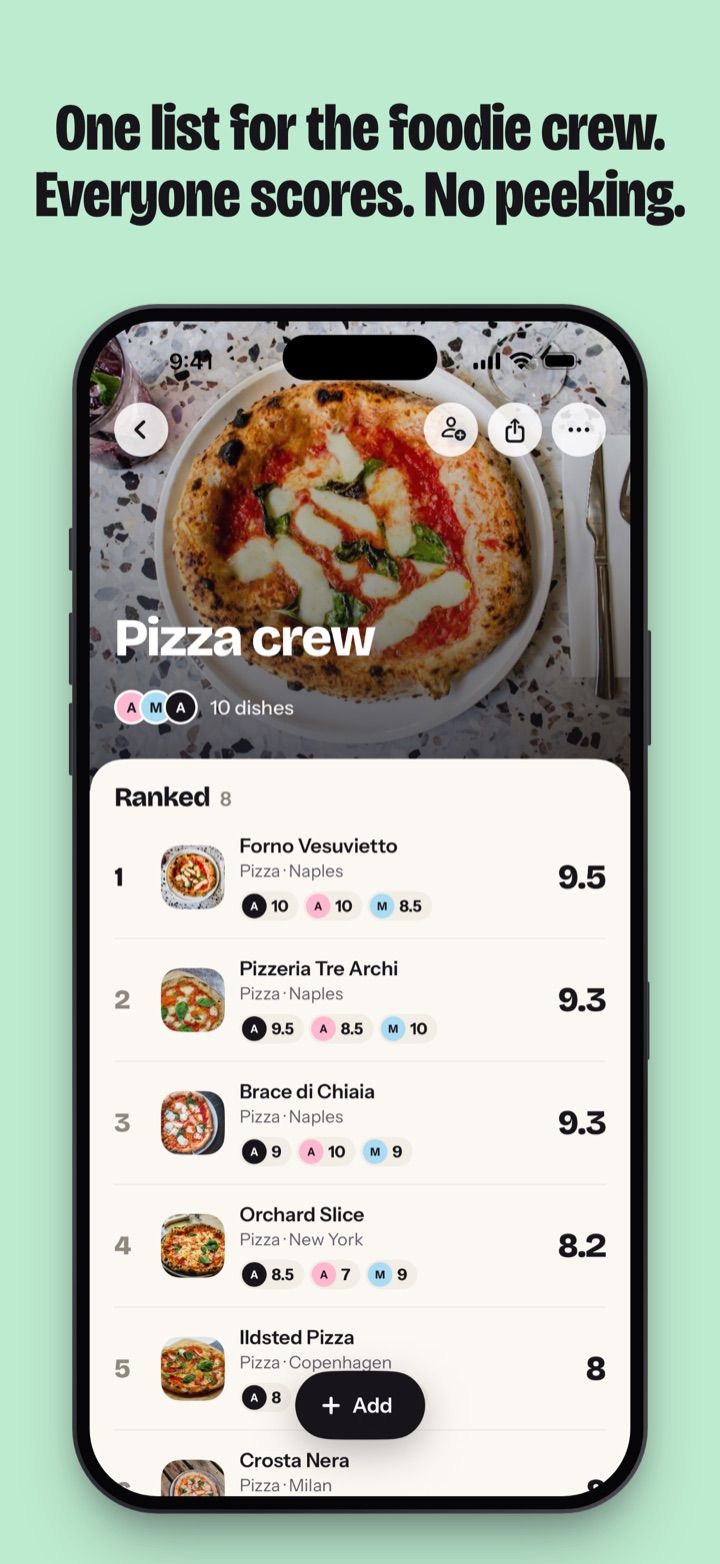
Start a list for a trip or a pizza crawl and invite friends through iCloud. Everyone adds dishes and scores them. You can’t see a friend’s score for a dish until you’ve scored it yourself or marked it Not tried, so their 9 can’t nudge your 7.
Once you’ve scored, the cards turn over and you see everyone’s score, plus the list score: the average of all of them. A dish can end up “#1 in Pizza crew”. Each friend needs Matcha on an iPhone, with Matcha Pro or the free trial. More in rate restaurants with friends.
6. Google Maps lists, imported on your iPhone
If your places live in Google Maps lists, bring them along. Share a list from Google Maps to Matcha, or paste its link in Profile › Import from Google Maps. Matcha reads the list on your iPhone, so it goes from Google straight to your phone. A Google Maps list holds up to 3,000 places, and Matcha can take all of them.
The places come grouped by city, every one ticked. Untick what you don’t want, and the rest land on your map as saved places, shown as small ink pins. The list has to be set to Shared in Google Maps first, and importing it again skips places already in Matcha. Step by step: Google Maps list to iPhone. For a copy of your lists as files, see export Google Maps saved places.
7. Share cards for your top 5, your #1 or a podium
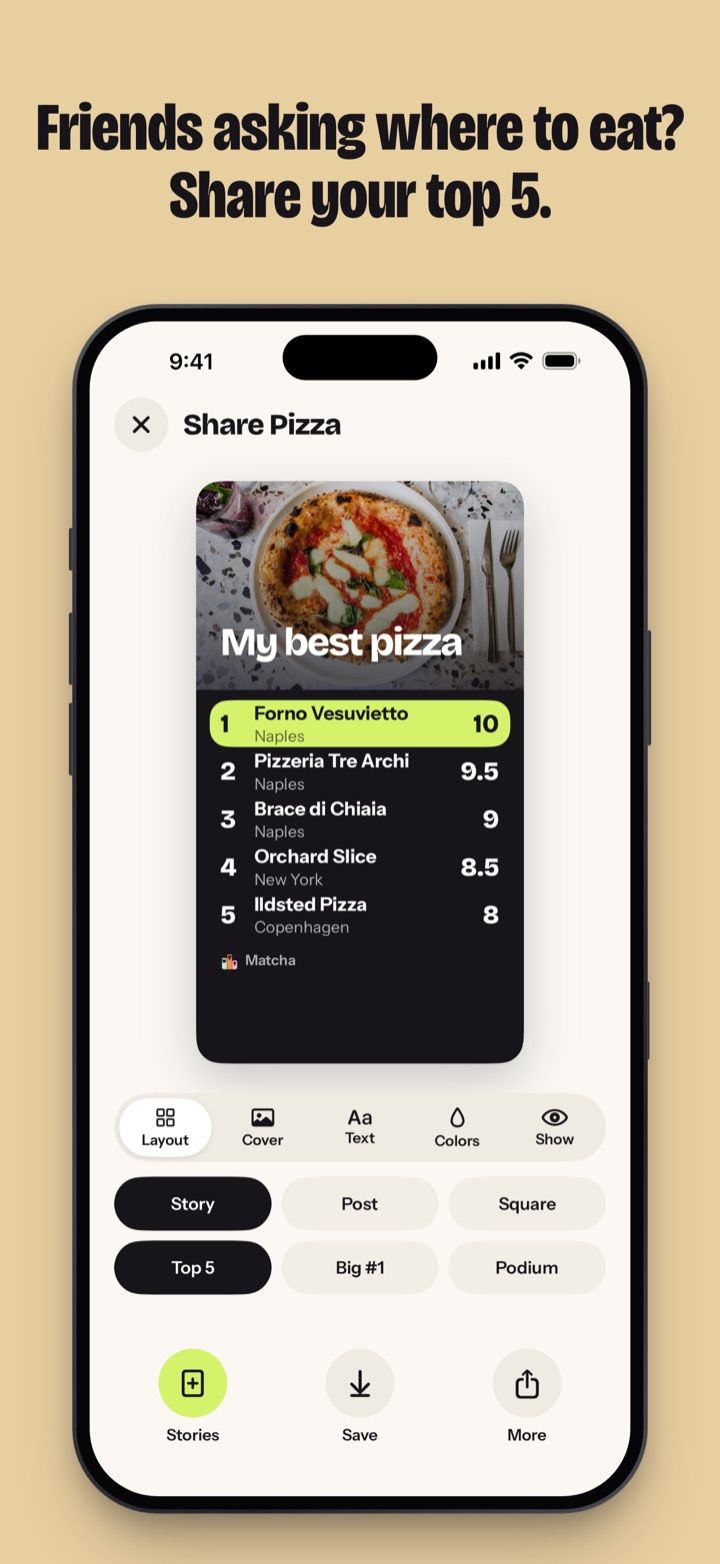
Any food, city, list or year can become an image: a top 5, a big #1 or a podium, sized for a Story, a post or a square. You pick the cover photo, the text and the colours, and whether scores, cities and prices show. A single dish gets a card too, as a full photo or a Polaroid. Friends don’t need Matcha to see an image.
The year card comes from Your year in food, Matcha’s recap of the dishes you scored that year. It counts your dishes and cities, your new #1s, the food you ate most, what you spent and your best month. It opens any day of the year, and its card is titled “Best of 2026” unless you change it.
To pass on the places themselves, Send my places makes a link. A friend with Matcha gets a copy in their Want to try with your dish and score, and nothing comes back to you.
8. Nine languages
The app is in English, Spanish, French, German, Italian, Portuguese (Brazil), Dutch, Japanese and Korean, and it follows your iPhone’s language. As of October 2026, Beli’s App Store listing shows English only, and Savor is in English only too (Beli alternatives has the sources).
Matcha next to other kinds of food app
“Star-rating apps” means apps and map services where the public rates places. “Saved-places maps” means apps for pinning places you like or want to visit. The table shows what’s typical of each kind as of October 2026, and single apps differ. The alternatives page names them.
| Star-rating apps | Saved-places maps | Matcha | |
|---|---|---|---|
| What gets a score | The whole restaurant | Usually nothing; some let you star a place | Each dish, 1 to 10 in half steps |
| Whose taste | An average of many reviewers | Yours, in notes and tags | Yours, plus friends’ in a list you share |
| What you see first | Highly rated or nearby places | Your pins, by folder or tag | Your best of each food, by city, restaurant or year |
| Who sees what you add | Reviews are usually public | Private, shared or public, depending on the app | Only you, until you share |
| Places to try | A bookmark or saved list | The main job | Want to try, with the dish to order |
| Scoring with friends | Everyone reviews separately | Shared lists, usually without scores | Shared lists, scores hidden until you’ve scored |
| Account | Usually needed to post or save | Usually needed | None |
| Devices | Usually phone and web | Usually phone and web | iPhone only (iOS 26 or later) |
| Price | Usually free | Free, often with a paid tier | Free download; 7-day free trial, then $9.99/year, or $0.99/week |
Where other apps do better
- Android, iPad and the web. Matcha is an iPhone app and needs iOS 26 or later. Beli, Mapstr and Google Maps all run on Android.
- Price. Google Maps lists are free, and Mapstr is free up to 300 places (as of October 2026). Matcha is a free download with a 7-day free trial, then $9.99/year, or $0.99/week without a trial. Other plans may show in the app, prices vary by country, and nothing is free after the trial (pricing).
- Finding new places. Google Maps reviews show what lots of people thought of a restaurant before you go, and Beli recommends places from a large community. Matcha only knows what you and your friends scored.
- Public maps. Mapstr lets you follow friends’, magazines’ and creators’ maps. In Matcha you share on purpose, one card, link or list at a time.
Side-by-side pages: Beli alternatives, Mapstr alternative and Matcha vs Google Maps lists.
Read next
- Why Matcha exists: the problem it was made for
- Who Matcha is for, and who should pick something else
- How it works, from adding a dish to sharing a list
- FAQ for everything else